

“What If Every Ray of Sunlight Put Money Back in Your Pocket?”
What if every ray of sunlight hitting your rooftop actually paid you back? That’s not science fiction, it’s the benefit of the net metering.
As India continues its rapid shift toward renewable energy, net metering has become a key policy tool helping millions of homes and businesses slash electricity bills, earn credits for surplus energy, and accelerate solar adoption.
Let’s break down the benefit of net metering, how it works, and why it’s considered the cornerstone of smart solar energy in 2025.
What Is Net Metering and How Does It Work?
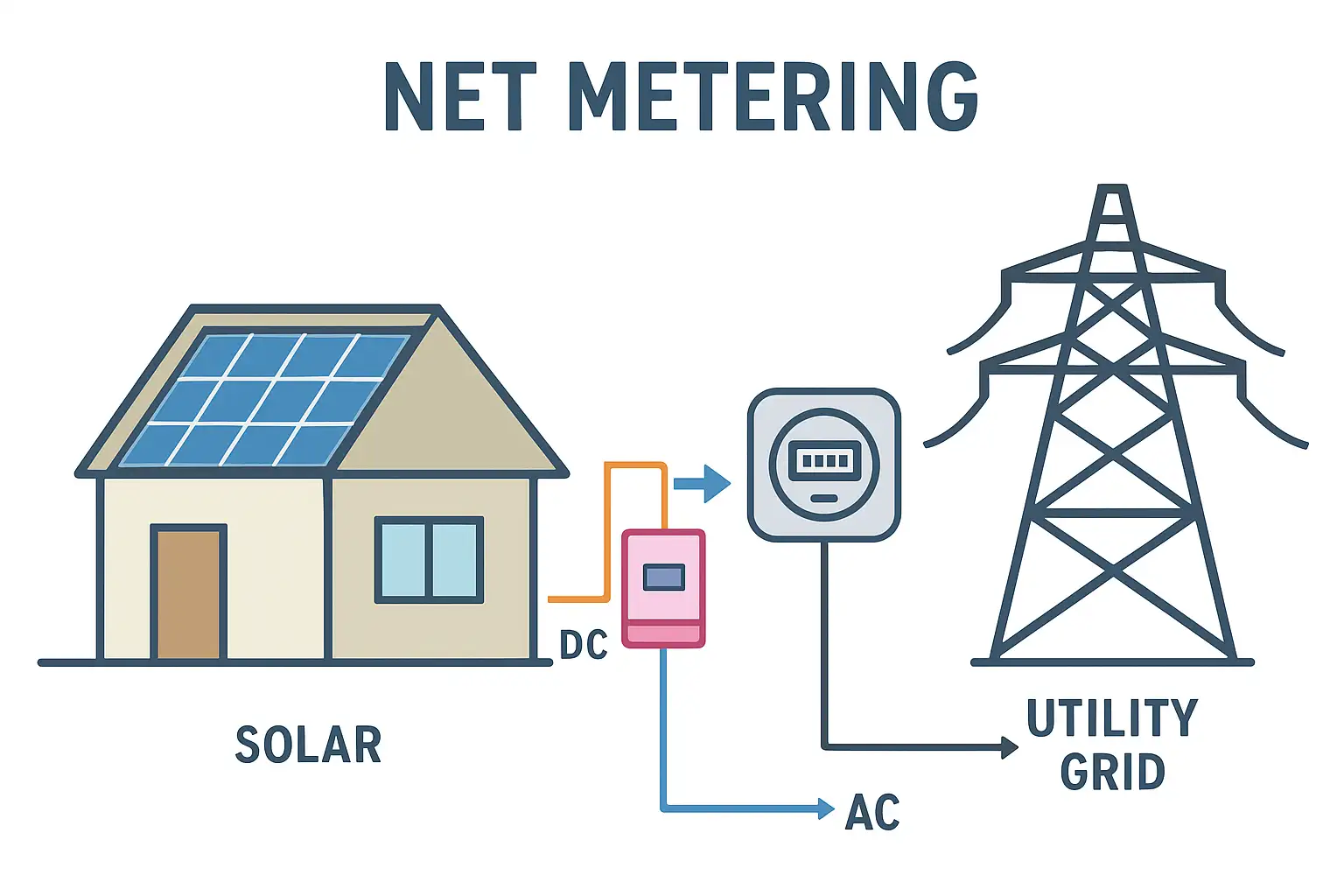
Net metering is a billing arrangement that allows solar energy producers, homeowners, businesses, or industries to feed excess electricity generated by their solar panels back into the grid.
When your panels produce more than you consume, that surplus energy is exported to the power grid, and you earn credits from your electricity provider. Later, when your system generates less power (like at night), you can draw from those credits.
At the end of each billing cycle, you only pay for the net difference between your consumption and your generation. That’s the simplicity and power of net metering.
The Benefit of the Net Metering for Homeowners:
For residential users, the benefit of the net metering goes beyond lower power bills, it’s about long-term energy independence.
Key advantages include:
- Significant Bill Reduction: Homeowners can reduce electricity costs by up to 80%, depending on system capacity and sunlight exposure.
- Virtual Energy Storage: The grid acts as your virtual battery, eliminating the need for costly energy storage systems.
- Fast ROI: Typical residential solar setups recover investment within 4–6 years.
- Eco-Friendly Impact: Each solar-powered home contributes to cleaner air and lower CO₂ emissions.
The Benefit of the Net Metering for Businesses and Industries
For commercial and industrial users, the benefits of net metering are even more substantial:
- Lower Operational Costs: Solar-generated energy offsets high daytime power consumption, reducing overall expenses.
- Higher Return on Investment: By exporting excess power, businesses maximize asset utilization without extra infrastructure.
- ESG and Brand Value: Adopting solar with net metering strengthens environmental credibility and attracts sustainability-conscious partners.
- Government Incentives: Many states offer subsidies and accelerated depreciation for net-metered solar systems.
Net Metering Cost Benefit Analysis (2025)
According to recent renewable energy data:
- Average payback period: 4.2 years
- Annual household savings: ₹18,000–₹25,000 for every 3 kW installed
- 20-year net savings: ₹5–6 lakh per household
In short, the net metering cost-benefit analysis shows that the financial advantage rivals and often exceeds that of traditional investments, making it one of the smartest energy moves for 2025.
Why Net Metering Is Vital for India’s Solar Growth?
Beyond individual savings, the benefit of the net metering plays a crucial national role:
- Stabilizes the grid by decentralizing energy production
- Reduces dependency on fossil fuels
- Promotes private investment in renewable energy
- Creates thousands of jobs in installation, maintenance, and manufacturing
It’s not just a billing mechanism, it’s a bridge to a cleaner, more resilient energy economy.
Real Impact: Numbers Tell the Story
| Metric | 2020 | 2025 (Projected) |
| Households with Solar | 200,000 | 1.2 million+ |
| Average Monthly Savings | ₹1,200 | ₹3,000+ |
| Solar Share in National Grid | 8% | 17% |
These numbers underscore how the benefit of the net metering has fueled India’s journey toward becoming a renewable powerhouse.
Conclusion: The Future Is Net Positive
In 2025 and beyond, the benefit of the net metering will continue to reshape how India consumes and produces energy.
Whether you’re a homeowner cutting monthly costs or a business aiming for sustainable operations, net metering offers a rare win-win: economic reward and environmental impact.
If you’re planning to install solar, talk to your local energy provider today and activate the benefits of net metering to make every ray of sunlight work for you.
Frequently Asked Questions (FAQs)
Ques 1. What is the benefit of the net metering?
Ans. It allows solar users to earn credits for surplus power they feed into the grid, reducing overall electricity bills.
Ques 2. How does net metering help homeowners?
Ans. It cuts monthly electricity costs and speeds up the payback period for solar panel investments.
Ques 3. What’s included in the net metering cost benefit analysis?
Ans. It considers installation costs, energy savings, and payback period to determine total long-term ROI.
Ques 4. Do I need batteries if I have net metering?
Ans. No. The grid acts as a virtual battery, storing excess energy as credits.
Ques 5. Is net metering available in every Indian state?
Ans. Most states offer net metering, but the policy terms and credit rates differ regionally.
Ques 6. What’s the average solar ROI with net metering?
Ans. Between 4–6 years depending on location, sunlight exposure, and system size.