
Have you ever wondered how your electricity meter could actually run backward? That’s not science fiction, it’s what happens with Net Metering, a system that rewards you for generating your own solar power.
As more homeowners turn to solar energy, understanding what net metering is and how it works can help you save money and make your home more energy efficient.
What is Net Metering?
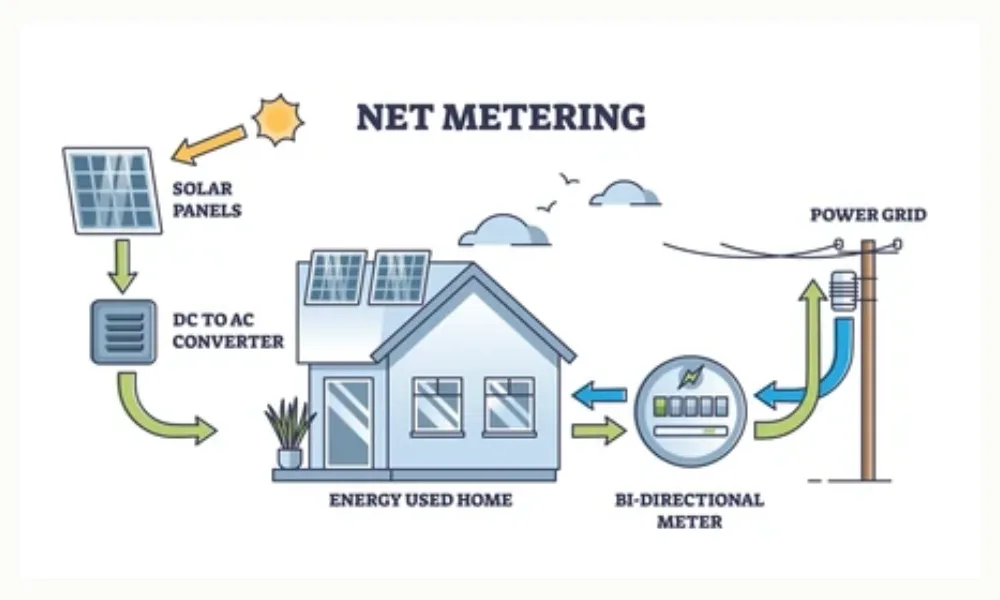
It is a billing mechanism that allows you to send excess electricity produced by your solar panels back to the power grid. In return, your electricity provider gives you credits for the energy you contribute.
These credits offset the power you consume from the grid when your solar panels aren’t generating enough, such as at night or during cloudy weather. In simple terms, it lets you “store” your extra electricity in the grid and use it later, ensuring that nothing goes to waste.
Example:
If your solar system generates 400 units of power but your home uses 350 units, the extra 50 units go to the grid. In your next bill, those 50 units are subtracted from your total consumption.
How does this system work?
> Generation – Your rooftop solar system produces electricity during the day.
> Export – Any extra energy your home doesn’t use goes to the electricity grid through a solar net meter.
> Credit – Your meter records the energy you send (export) and the energy you use (import).
> Billing – At the end of the billing cycle, your electricity provider calculates your net usage. You pay only for the difference, or even earn credits if you exported more than you consumed.
The Benefits of Net Metering:
The benefit of the net meter system extends far beyond lower bills. It offers both financial and environmental rewards:
-
Lower Electricity Bills: Pay only for what you consume after deducting the credits earned.
-
Faster Payback: Net metering helps recover the cost of your solar investment faster.
-
Reduced Carbon Footprint: By sharing clean energy with the grid, you help reduce dependency on fossil fuels.
-
Energy Independence: You rely less on DISCOM-supplied power and more on your own production.
-
Government Support: Many Indian states have net metering policies under the MNRE (Ministry of New and Renewable Energy) that make solar adoption easier.
How to Apply for Solar Net Metering?
Applying for solar net meter setting up is a straightforward process, though it can vary by state or utility provider. Here’s a simplified version of the net metering application process:
- Contact Your DISCOM: Reach out to your state’s electricity distribution company.
- Submit Application: Fill out the solar net meter application form, typically available online on your DISCOM’s website.
- Site Inspection: A technical team will visit to check feasibility.
- Installation Approval: Once approved, your solar system and bidirectional meter are installed.
- Grid Synchronization: The system is connected to the main grid, and your net metering officially begins.
Net Metering vs. Gross Metering:
While Net Meter use is the most popular option for homes, it’s often confused with Gross Metering.
Here’s the key difference:
- Net Meter: You use solar power first and export the excess. You’re billed only for the net energy consumed.
- Gross Metering: All generated solar power is sold to the grid at a fixed rate, and you buy all your electricity from the grid separately.
For most homeowners, Net Metering is the smarter choice it directly reduces monthly bills instead of earning small fixed-rate credits.
Summery:
Net Meter billing system is one of the most effective ways to make solar energy rewarding and sustainable. It ensures that every unit your system produces benefits you either by powering your home or by reducing your electricity bill.
As solar adoption grows across India, net metering stands out as the bridge between clean energy and smart savings.
Ready to get started?
👉 Go Solar today — from on-site survey to installation, subsidy, and net metering application assistance, we make the switch effortless.
Frequently Asked Questions (FAQs)
Ques 1. How does the Net Meter system work?
Ans. Your solar panels generate electricity during the day. If you produce more than you use, the extra power goes to the grid. Later, you use those credits when your system produces less power.
Ques 2. What is the benefit of the Net Meter system?
Ans. The main benefit of net metering is reduced electricity bills. You pay only for the net amount of energy you consume after exporting surplus power to the grid.
Ques 3. Is it available for residential homes in India?
Ans. Yes, net metering is available in most Indian states for residential rooftop solar systems under MNRE guidelines.
Ques 4. Who is eligible for Net Meter billing system?
Ans. Any residential, commercial, or institutional consumer with a grid-connected solar system and DISCOM approval is eligible for net metering.
Ques 5. How do I apply for a solar Net Metering connection?
Ans. You can apply through your state’s electricity board (DISCOM) website or via a registered solar installer who handles the application and approval process.
Ques 6. How long does it take to approve the Net Meter billing system?
Ans. Depending on your state, approval usually takes 15–45 days after submission of your application and site inspection.
Ques 7. What happens if I generate more electricity than I consume?
Ans. You earn energy credits for the excess power, which can be used in future billing cycles to offset your electricity consumption.