Have you ever wondered which nations are leading the world in solar power production?
Identifying the Top 10 Solar Energy Producing Countries gives a clear view of global renewable progress and where investment, policy and technology meet in real terms.
The Top 10 Solar Energy Producing Countries in 2025:
1. China:
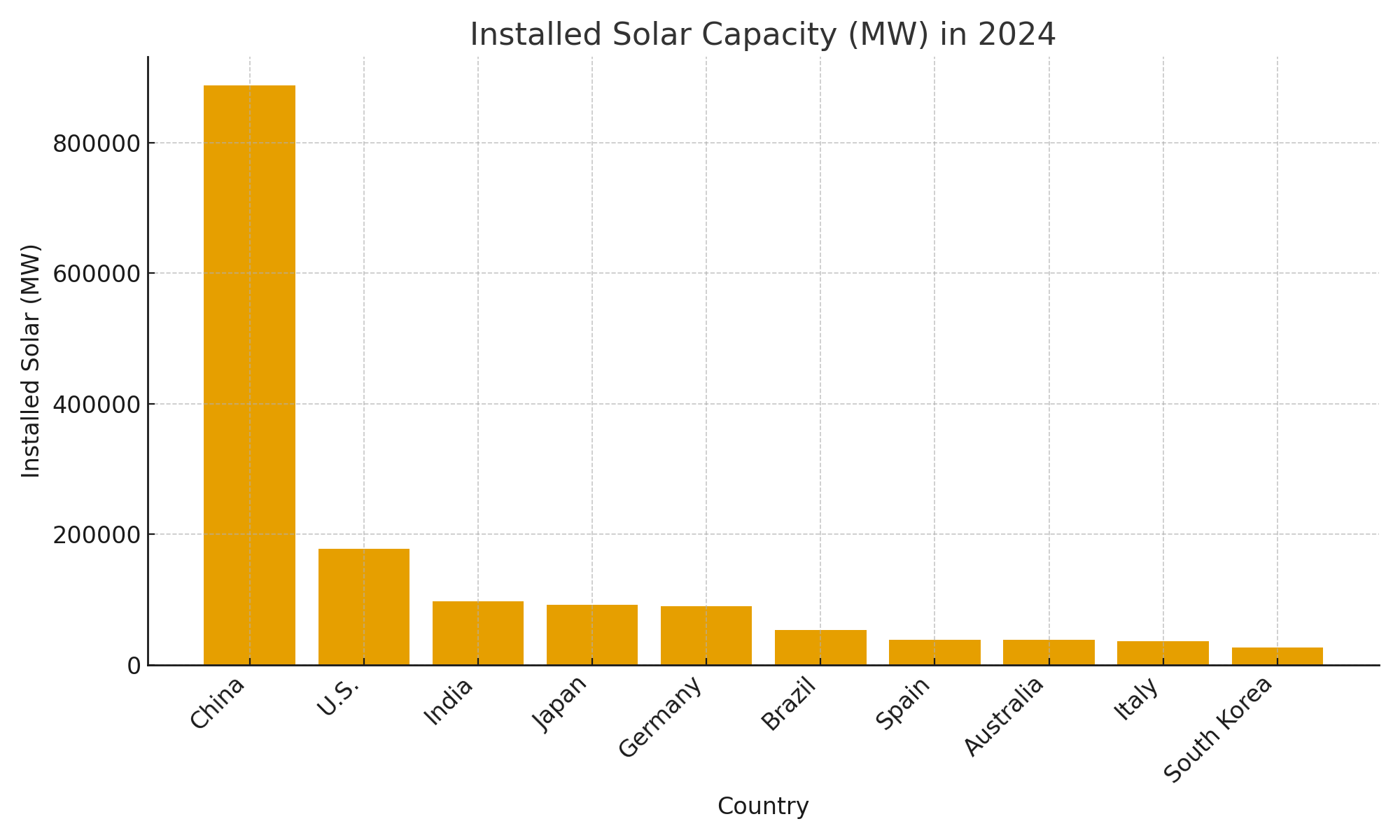
China remains the clear leader among the Top 10 Solar Energy Producing Countries, holding nearly 888 GW of installed solar capacity.
Backed by massive solar farms, strong government policies, and ambitious clean-energy goals, China continues to expand at an incredible pace.
In 2024 alone, it added over 278,000 MW, surpassing the total solar capacity of many countries and firmly shaping the global future of solar energy.
2. United States:
The United States holds the second spot among the Top 10 Solar Energy Producing Countries, driven by rising public adoption and strong federal incentives.
From vast solar farms in the Southwest to widespread rooftop systems in states like California, solar power is now a key part of the U.S. energy mix. In 2024, the nation added over 38,000 MW, further speeding its transition to a cleaner grid.
3. India:
India holds a strong position among the Top 10 Solar Energy Producing Countries, expanding rapidly through major utility-scale projects and widespread rooftop adoption.
With over 97 GW installed and a strong growth rate of 33.7%, India’s solar development is most visible in high-sunlight states like Rajasthan, Gujarat, and Karnataka.
Solar energy remains central to India’s plan to meet rising electricity demand while progressing toward its 2030 emission goals and long-term Net-Zero target for 2070.
4. Japan:
Japan remains an important player among the Top 10 Solar Energy Producing Countries, with 91.6 GW of installed capacity.
Although its solar growth has slowed in recent years due to land constraints and regulatory challenges, the country still relies heavily on residential, commercial, and industrial rooftop systems. Japan’s earlier post-Fukushima solar surge continues to support its strong overall capacity.
5. Germany:
Germany, an early leader in clean energy, continues its steady solar growth with nearly 90 GW installed and over 20% yearly expansion.
Supportive policies, strong incentives, and innovation have helped Germany thrive in solar power despite limited sunshine, keeping it a key influencer in the global renewable energy landscape.
6. Australia:
Australia stands eighth globally with more than 38 GW of solar capacity, driven by one of the world’s highest rooftop solar adoption rates, nearly one in three homes uses solar power.
Alongside growing utility-scale projects and steady annual growth of 15.6%, Australia’s intense sunlight and public participation continue to keep it a prominent leader in solar energy.
7. Brazil:
Brazil is quickly becoming Latin America’s solar leader, recording an impressive 40% growth in a single year.
With over 53 GW installed, its expansion is fueled by strong sunlight, lower equipment costs, and supportive government policies.
This rapid rise in solar power is helping Brazil reduce its reliance on hydropower and build a more balanced energy mix.
8. Spain:
Spain remains a key player among the Top 10 Solar Energy Producing Countries, supported by a strong comeback in solar installations.
With 38.5 GW installed and nearly 21% growth, the country is expanding both rooftop and large-scale solar projects. Favorable policies and a sunny climate continue to boost Spain’s clean energy progress.
9. South Korea:
South Korea remains an important part of the Top 10 Solar Energy Producing Countries, steadily boosting its solar capacity to nearly 27 GW despite limited land.
Supported by government programs, corporate investments, and smart energy technologies, the country achieved 13.4% growth. While expansion is gradual, South Korea’s focused strategy shows its strong commitment to renewable energy.
10. Italy:
Italy has shown strong progress in solar energy, recording a 22.7% rise and reaching 36 GW of installed capacity.
Positioned among the Top 10 Solar Energy Producing Countries, Italy benefits from favorable climate conditions, supportive incentives, and growing adoption in the south.
Its mix of residential systems and large solar plants continues to boost its momentum in Europe’s renewable energy landscape.
Why These Countries Are Leading?
Several factors explain why these nations dominate solar production:
- Strong government incentives and renewable energy targets.
- Mature manufacturing and installation ecosystems.
- Access to abundant solar irradiation or strong policy frameworks.
- Effective grid integration and investment in storage and smart systems.
India’s Rising Role in Solar Energy:
India is now firmly among the solar power leaders. It benefits from vast solar parks, rooftop programmes, and aggressive targets under its clean-energy mission. These efforts position India for a key role in global solar expansion.
What Does It Mean for You?
When you understand which nations rank among the Top 10 Solar Energy Producing Countries, you gain insight into:
- Global trends and investment flows in solar energy.
- How policy and technology interplay to drive clean-energy adoption.
- How your country or region might emulate practices from leaders.
The Road Ahead:
Solar power growth will not slow. Analysts expect major increases in solar capacity by 2030, with storage, smart grids and international investment driving the next phase. Leadership in solar today will shape global energy systems for decades.
External Sources for Further Reading:
Frequently Asked Questions (FAQs)
Ques 1. Is solar energy renewable or nonrenewable?
Ans. Solar energy is renewable because sunlight is abundant and naturally replenished.
Ques 2. Which country leads solar energy production in 2025?
Ans. China, with over 1,100 GW of installed solar capacity.
Ques 3. What factors drive solar energy growth globally?
Ans. Government incentives, renewable targets, technological innovation, and grid integration.
Ques 4. What role do government incentives play in solar growth?
Ans. They reduce costs, encourage adoption, and attract investment.
Ques 5. Will solar energy continue to grow after 2025?
Ans. Yes, analysts expect significant increases by 2030.
Ques 6. What are the environmental benefits of solar energy?
Ans. Reduced greenhouse gas emissions and cleaner air.